Author: Site Editor Publish Time: 2026-10-21 Origin: Site


Semi-rigid coaxial cable is commonly identified by its nominal outside diameter (OD). Sizes such as 0.034 inch, 0.047 inch and 0.141 inch refer to the cable's outer diameter, not the center conductor size.
The right cable size depends on the required impedance, operating frequency, cable length, attenuation, available installation space, connector type and environmental requirements. Smaller cables are useful for compact routing, while larger constructions can provide lower attenuation and greater power-handling capability when other design factors are comparable.
This guide compares common semi-rigid coax sizes and the key factors to consider when selecting a cable for RF and microwave applications.
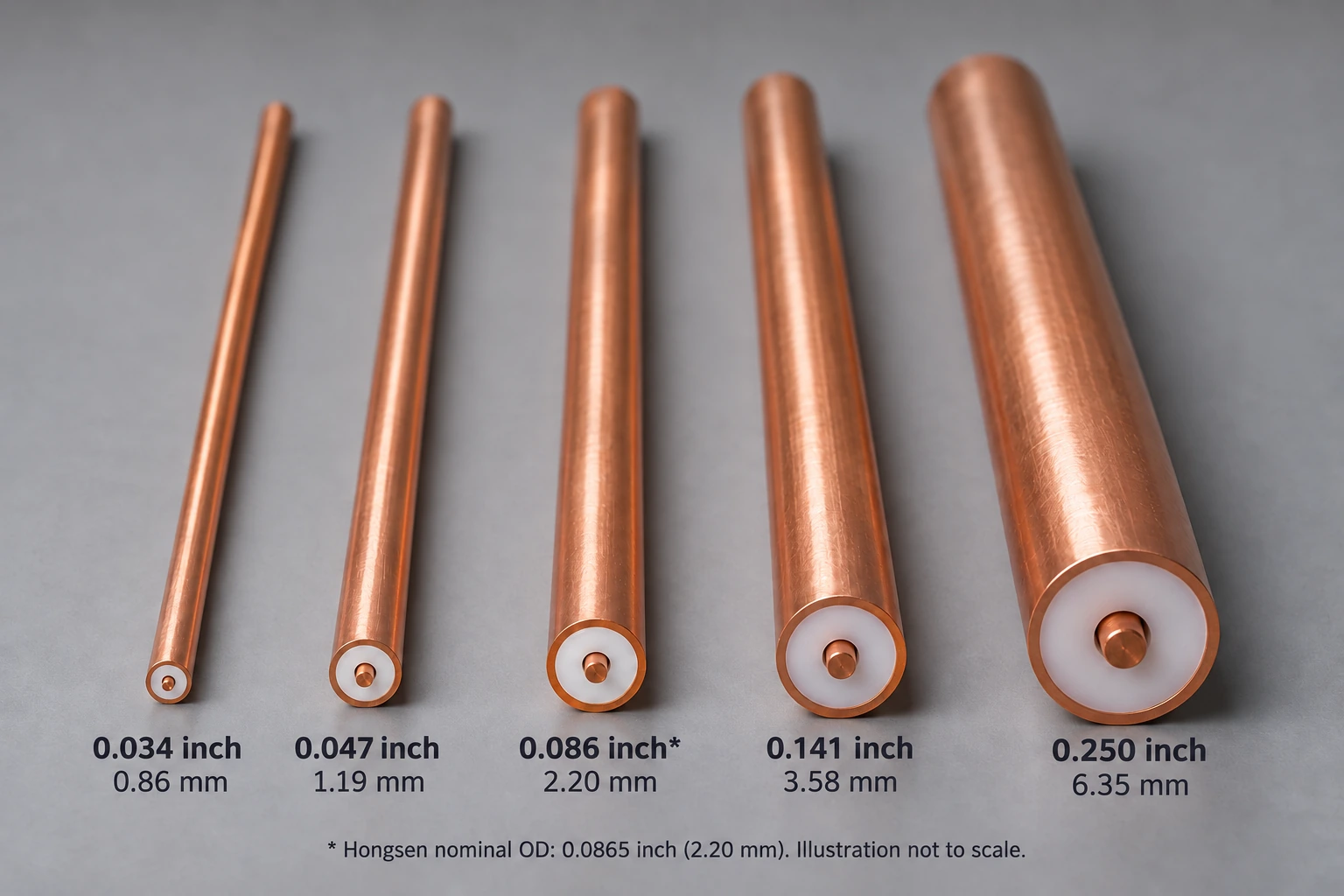
Hongsen Cable supplies semi-rigid coaxial cable from 0.034 inch (0.86 mm) to 0.250 inch (6.35 mm), with PTFE and LD PTFE dielectric options and multiple conductor and outer conductor materials. Impedance options vary by size and model.
| Nominal Size | Approx. OD | Typical Advantage | Key Consideration |
|---|---|---|---|
| 0.034 inch | 0.86 mm | Extremely compact | Higher attenuation and more demanding forming requirements |
| 0.047 inch | 1.19 mm | Compact with greater mechanical robustness | Requires more space than 0.034 inch |
| 0.086 inch | 2.20 mm | Balance of size and performance | Confirm impedance, attenuation and construction by model |
| 0.141 inch | 3.58 mm | Lower attenuation and greater mechanical robustness | Requires more routing space |
| 0.250 inch | 6.35 mm | Suitable for low-loss and higher-power designs | Largest size in this comparison; less suitable for tight routing |
The industry commonly uses the "0.086 inch" designation. Hongsen Cable's corresponding series has a nominal outside diameter of 0.0865 inch (2.20 mm).
Cable diameter is one of several factors that determine the overall performance and usability of a semi-rigid coaxial cable.

Installation space: Smaller cables require less routing space and are easier to integrate into compact RF modules and enclosures.
Attenuation: For comparable cable constructions, larger diameters generally have lower attenuation than smaller sizes.
Power handling: Larger cable constructions may support higher power levels, depending on the specific design and operating frequency.
Forming and routing: Smaller cables are suitable for compact layouts, but semi-rigid cable must be formed carefully to avoid deformation of the outer conductor.
Connector compatibility: The connector must match the cable OD, impedance and assembly configuration.
Materials: The same nominal size may be available with different dielectric, center conductor and outer conductor materials.
Cable diameter should therefore be considered together with the electrical and mechanical requirements of the application.
The 0.034 inch and 0.047 inch sizes are used where installation space is limited. Both are suitable for compact RF modules, microwave assemblies and internal point-to-point interconnects.
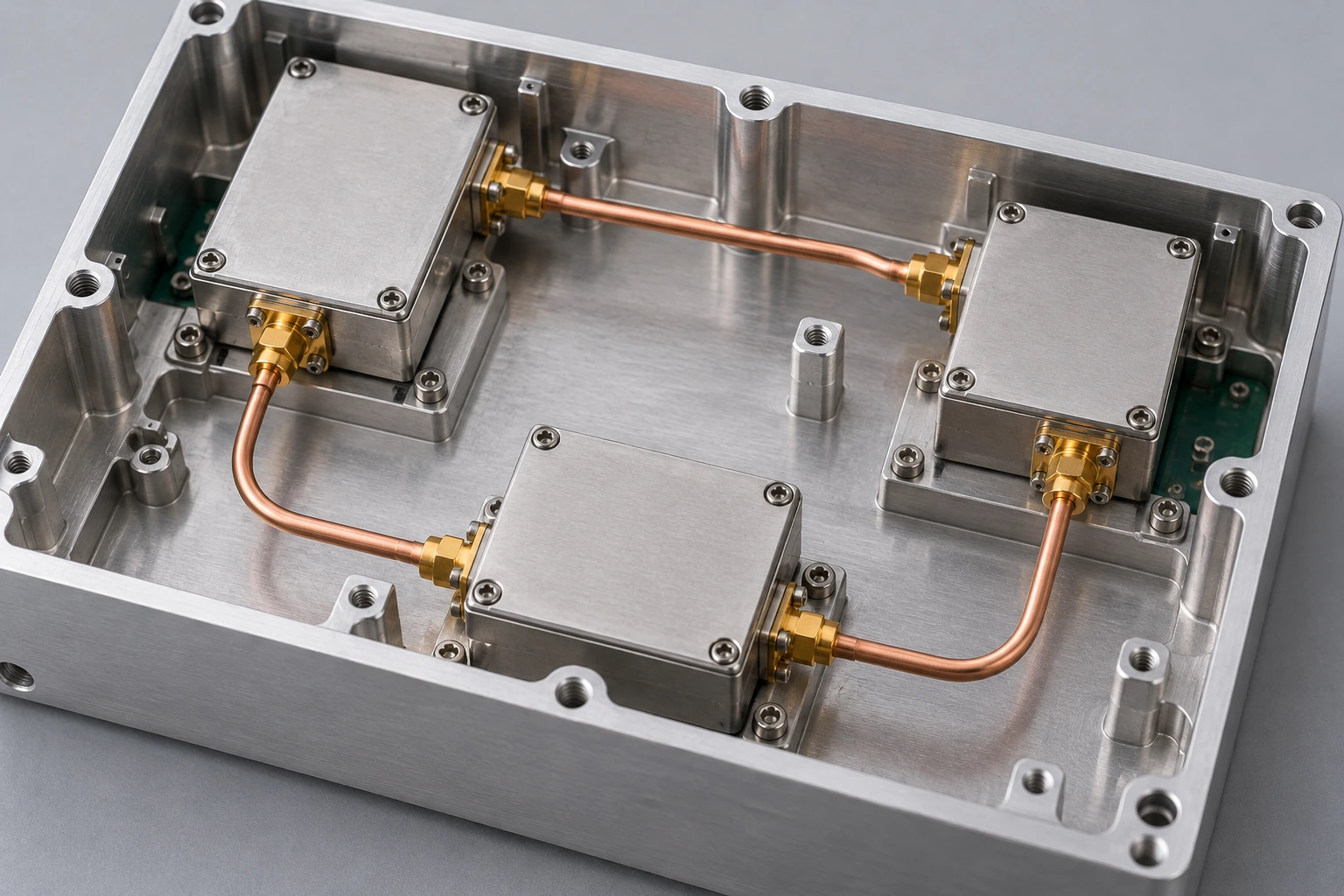
With an OD of approximately 0.86 mm, 0.034 inch is one of the smallest commonly available semi-rigid coax sizes.
Hongsen's 0.034 inch range includes 50Ω configurations with PTFE dielectric and seamless copper, tin-plated copper or silver-plated copper outer conductors. A 10Ω configuration is also available for specialized impedance requirements.
Common applications:
Compact RF and microwave modules
Space-constrained internal interconnects
Formed RF connections
Specialized low-impedance designs
Confirm cable length, attenuation, forming requirements and connector compatibility before selecting this size.
The 0.047 inch size has an OD of approximately 1.19 mm. It remains compact while providing more mechanical robustness than 0.034 inch cable.
Hongsen offers 50Ω 0.047 inch models with PTFE dielectric and seamless copper, tin-plated copper or silver-plated copper outer conductors.
Common applications:
RF module interconnects
Compact microwave assemblies
Internal RF connections
Space-constrained electronic equipment
Choose between 0.034 and 0.047 inch based on available space, attenuation, forming requirements and connector configuration.
The 0.086 inch designation is widely used in RF and microwave engineering. Hongsen's corresponding cable family has a nominal OD of 0.0865 inch (2.20 mm).
Hongsen's 0.0865 inch range includes:
25Ω, 50Ω and 75Ω impedance options
PTFE and selected LD PTFE dielectric constructions
Seamless copper, tin-plated copper, silver-plated copper and tin-plated aluminum outer conductors
Silver-plated copper and silver-plated copper-clad steel center conductor options
Common applications:
RF and microwave assemblies
Test and measurement equipment
Wireless communication equipment
Internal equipment interconnects
Designs requiring different impedance or conductor configurations
For a specific application, check the individual model's attenuation, operating frequency, power rating and connector compatibility rather than selecting by OD alone.
Larger semi-rigid coax sizes are generally considered when installation space is available and lower attenuation, mechanical robustness or power-handling capability is more important than minimum cable size.
With an OD of approximately 3.58 mm, 0.141 inch cable provides a larger transmission structure for RF and microwave assemblies.
Hongsen supplies 0.141 inch models in 25Ω, 35Ω, 50Ω and 75Ω configurations, with multiple center conductor and outer conductor material options.
Common applications:
Test and measurement equipment
RF and microwave assemblies
Longer internal RF routing paths
Applications where attenuation and mechanical robustness are important
Specialized impedance requirements
Compare the actual attenuation and power specifications of the selected model before choosing 0.141 inch over a smaller size.
With a nominal OD of approximately 6.35 mm, 0.250 inch is the largest size covered in this guide.
Hongsen offers 50Ω and 75Ω versions with PTFE dielectric and copper, tin-plated copper, silver-plated copper or tin-plated aluminum outer conductor options.
Common applications:
RF and microwave systems where low attenuation is important
Higher-power RF applications, subject to model specifications
Larger equipment enclosures
Fixed installations with sufficient routing space
The larger OD requires more installation clearance and a larger routing path. Confirm the cable's forming method, connector compatibility and rated performance before ordering.
| Selection Factor | What to Check | Typical Consideration |
|---|---|---|
| Impedance | 50Ω, 75Ω, 25Ω, 35Ω, 10Ω | Match the cable to the system impedance |
| Frequency | Operating frequency and bandwidth | Compare attenuation at the required frequency |
| Cable length | Total transmission path | Longer cable runs make attenuation more important |
| Installation space | Cable OD and routing clearance | Smaller sizes suit compact assemblies |
| Attenuation | Attenuation at the operating frequency | Larger diameters generally have lower attenuation when construction is comparable |
| Power | Required RF power level | Confirm the rated power of the specific cable model |
| Mechanical requirements | Forming, bend path, vibration and handling | Match the cable construction to the assembly process |
| Materials | Dielectric, center conductor and outer conductor | Select materials for the required electrical and environmental conditions |
| Connector | Cable OD, impedance and interface | Confirm connector compatibility before ordering |
50Ω is the most common choice for RF, microwave, wireless communication and test equipment.
75Ω is used for specific video, broadcast and measurement applications.
Selected Hongsen cable sizes are also available in 10Ω, 25Ω and 35Ω configurations for specialized designs.
Match the cable impedance to the system to minimize reflections and maintain the required transmission performance.
Compare the specified attenuation at the actual operating frequency and cable length. Do not estimate cable loss from diameter alone.
For longer cable runs or higher-frequency applications, attenuation can become a major selection factor.
Consider the complete cable route, including:
Cable OD
Routing clearance
Bend path
Connector termination area
Assembly access
Smaller sizes are useful for compact equipment, while larger sizes require more installation space.
If power handling or mechanical robustness is important, compare the rated performance of the specific cable models rather than selecting by diameter alone.
Semi-rigid cable also requires controlled forming. The forming method and allowable bend requirements should be considered during assembly design.
Check the dielectric, center conductor and outer conductor materials according to the electrical and environmental requirements of the application.
Available constructions may include PTFE or LD PTFE dielectric, copper or plated copper conductors, and different outer conductor materials.
Semi-rigid coax connectors are size- and configuration-specific. Confirm the cable OD, impedance, connector interface and termination method before ordering.
In addition to the main sizes above, Hongsen also offers:
0.043 inch (1.09 mm) semi-rigid coaxial cable, including a 10Ω configuration
0.090 inch (2.29 mm) semi-rigid coaxial cable, including a 25Ω configuration
These sizes provide additional options when a 0.034, 0.047, 0.0865, 0.141 or 0.250 inch cable does not match the required impedance, space or construction requirements.
The appropriate semi-rigid coax size depends on the complete electrical and mechanical requirements of the application.
When requesting a recommendation or quotation, provide:
Required impedance
Operating frequency
Cable length
Required attenuation or loss budget
Available installation space
Operating environment
Center and outer conductor requirements
Connector type and interface
Hongsen Cable can provide semi-rigid coaxial cable in different sizes, impedances and material configurations for RF and microwave applications.