Author: Site Editor Publish Time: 2026-11-19 Origin: Site


RG316 saves space; RG400 offers lower cable loss in a larger, double-shielded construction. The choice comes down to whether RG316 meets the loss budget at the required frequency and length, or whether the connection needs the lower attenuation of RG400.
Both are 50-ohm cables with PTFE insulation and an FEP jacket. Start by comparing their dimensions and loss, then check the installation and connector fit. A short internal jumper and a several-meter RF connection can lead to different choices.
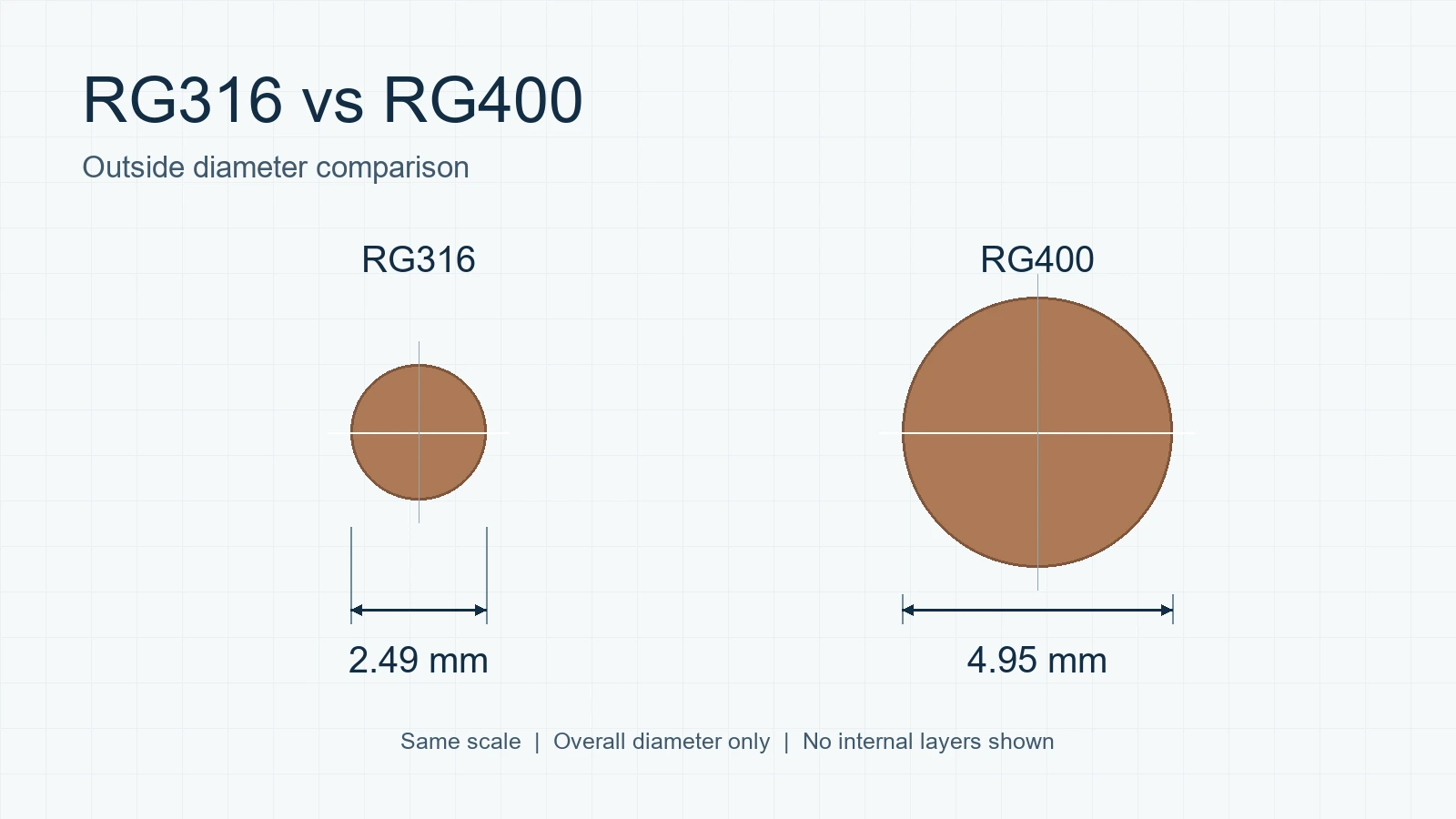
The table summarizes the main construction differences. Dimensions refer to the Hongsen products linked below; confirm the offered cable specification when ordering.
| Feature | RG316 | RG400 |
|---|---|---|
| Nominal outside diameter | 2.49 mm | 4.95 mm |
| Center conductor | 7 strands of 0.17 mm silver-plated copper-clad steel | 19 strands of 0.203 mm silver-plated copper |
| Shield construction | One silver-plated copper braid | Two silver-plated copper braids |
The RG400 outside diameter is approximately twice that of RG316. That does not mean it needs only twice the routing area: clips, connector bodies and bend clearance must also fit. The conductor strand sizes above describe individual wires, not the finished conductor bundle diameter.
The attenuation difference is the main reason to consider the larger RG400. The specifications below compare both cables at the same temperature and frequencies:
| Frequency | RG316 maximum attenuation | RG400 maximum attenuation |
|---|---|---|
| 100 MHz | 27.2 dB/100m | 12.5 dB/100m |
| 400 MHz | 54.8 dB/100m | 25.9 dB/100m |
| 1 GHz | 90.2 dB/100m | 43.0 dB/100m |
| 3 GHz | 155.2 dB/100m | 79.4 dB/100m |
Published maximum attenuation at 20°C. References: Hongsen RG316 specification and RG400 specification. These are cable figures, excluding connector losses.
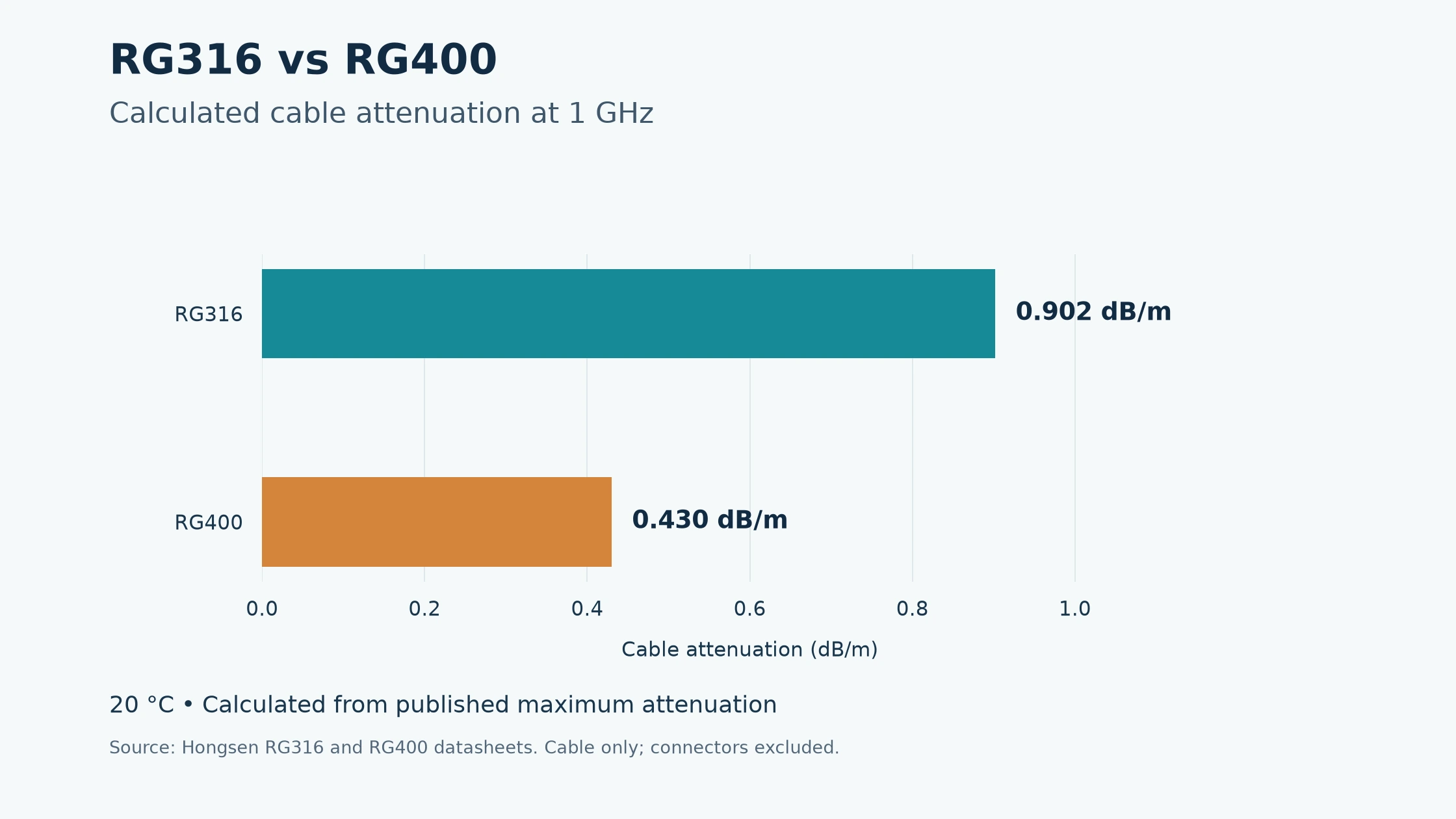
To estimate cable loss, multiply the dB/100m figure by the length in meters and divide by 100. At 1 GHz, that gives:
0.2 m connection: approximately 0.180 dB for RG316 and 0.086 dB for RG400.
5 m connection: approximately 4.51 dB for RG316 and 2.15 dB for RG400.
These are scaled estimates from published maximum values, not measured assembly results. They show why the selection changes with length. In a short jumper, the space saved by RG316 may be worth the additional cable loss. Over several meters, RG400's lower attenuation can make a much larger difference to the RF path. Add connector losses when checking the complete connection.
RG316 is the first cable to evaluate when a small RF module, crowded enclosure or closely spaced connector limits the available route. Its smaller body can help keep a short internal connection compact.
Start with RG316 when the route is short, space is restricted and its calculated loss fits the equipment's budget.
Allow room for RG400 when the electrical requirements justify the larger cable, including its connector and strain relief.
Both cables have stranded center conductors. Their different diameters and overall constructions affect routing, so check the specified bend radius for the offered cable and assembly. A smaller diameter alone does not establish a continuous flexing rating.
RG400 adds a second braid shield compared with the standard RG316 construction shown above. That makes it worth evaluating when shielding is a selection priority, but braid count alone cannot establish the isolation of a finished assembly. Shield termination and connector performance also matter.
The same connector interface does not mean the same cable termination. An SMA connector for RG316 and an SMA connector for RG400 may mate with the same equipment port while requiring different contacts, ferrules and stripping dimensions.
Before changing cable size, check:
The exact connector part number and approved cable types.
The contact dimensions, ferrule and assembly tooling.
The connector body's clearance and the cable support behind it.
| Your main constraint | Cable to evaluate first | What confirms the choice |
|---|---|---|
| A short route inside compact equipment | RG316 | It fits the route and meets the complete loss budget |
| Several meters of RF cable or limited loss margin | RG400 | Its lower attenuation meets the target and sufficient routing space is available |
| A need to evaluate double-braid construction | RG400 | Required shielding and termination performance are confirmed |
| Replacing an existing cable | The original specified type | Any substitution meets electrical, mechanical and connector requirements |
The RG316 cable is the compact option in this comparison. The RG400 cable provides a larger construction with lower published attenuation at the frequencies shown. Choose using the actual route and operating frequency, rather than a general preference for the smallest or largest cable.
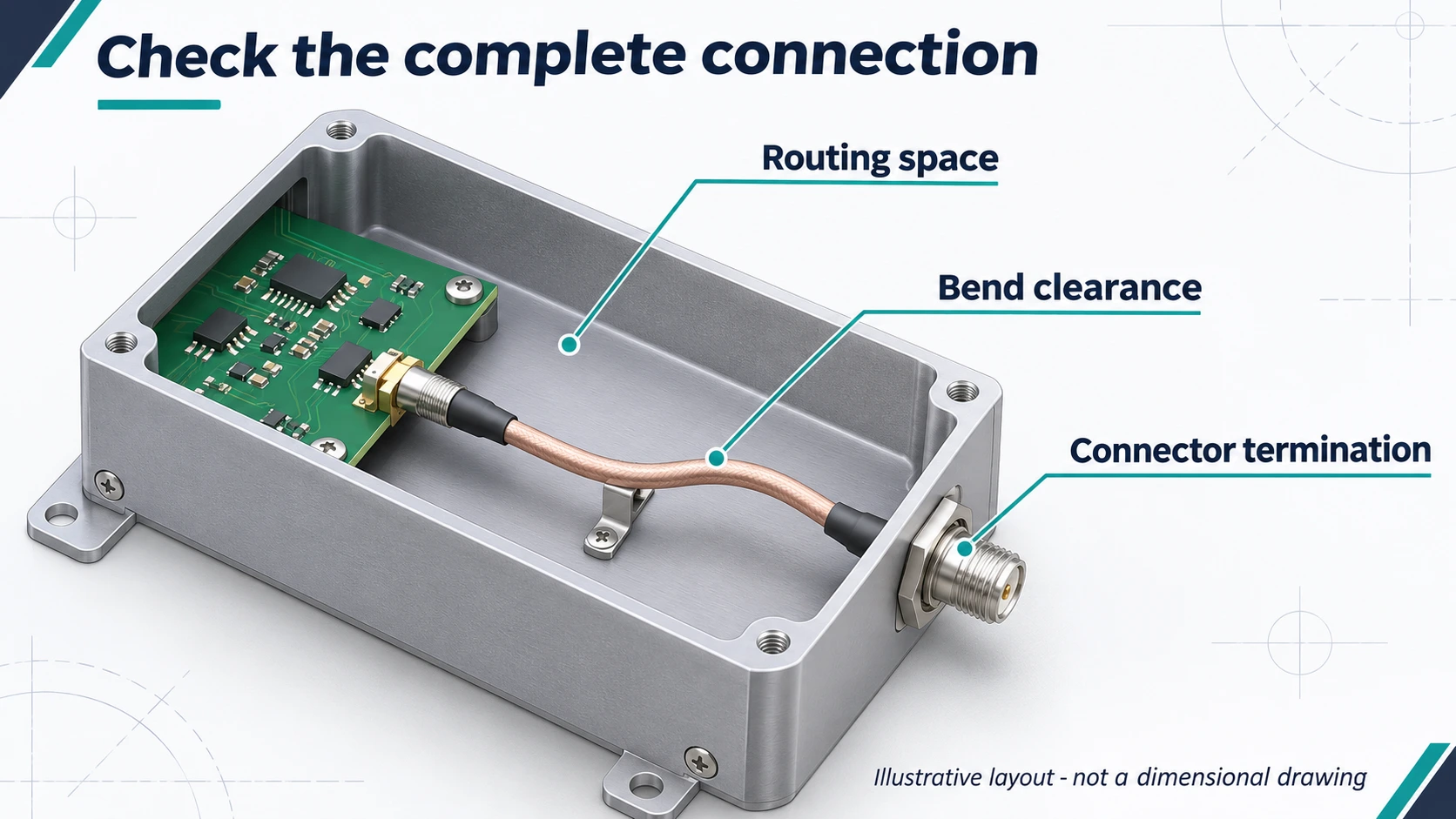
It can be a candidate when lower loss is needed, provided the larger diameter, bend clearance and connector termination fit. Matching 50-ohm impedance alone is insufficient.
Do not derive a power rating from cable size or operating voltage alone. Check the applicable RF power limits at your frequency and temperature, including the connector limits. The loss table above does not establish an assembly power rating.
Calculate the loss at the required frequency before choosing it. The table shows attenuation increasing with frequency, so a route that works at a lower frequency may use too much loss margin at a higher one. If RG400 also exceeds the budget, evaluate a different cable construction.
Hongsen supplies both constructions in its RG coaxial cable range. If you are working within a tight enclosure or comparing cable loss for a longer route, we can discuss the relevant cable specification and termination requirements with you.
If you are deciding between the two, send us the operating frequency, cable length and connector details. A drawing of a restricted route helps us understand the space available and discuss a suitable construction for your connection.